

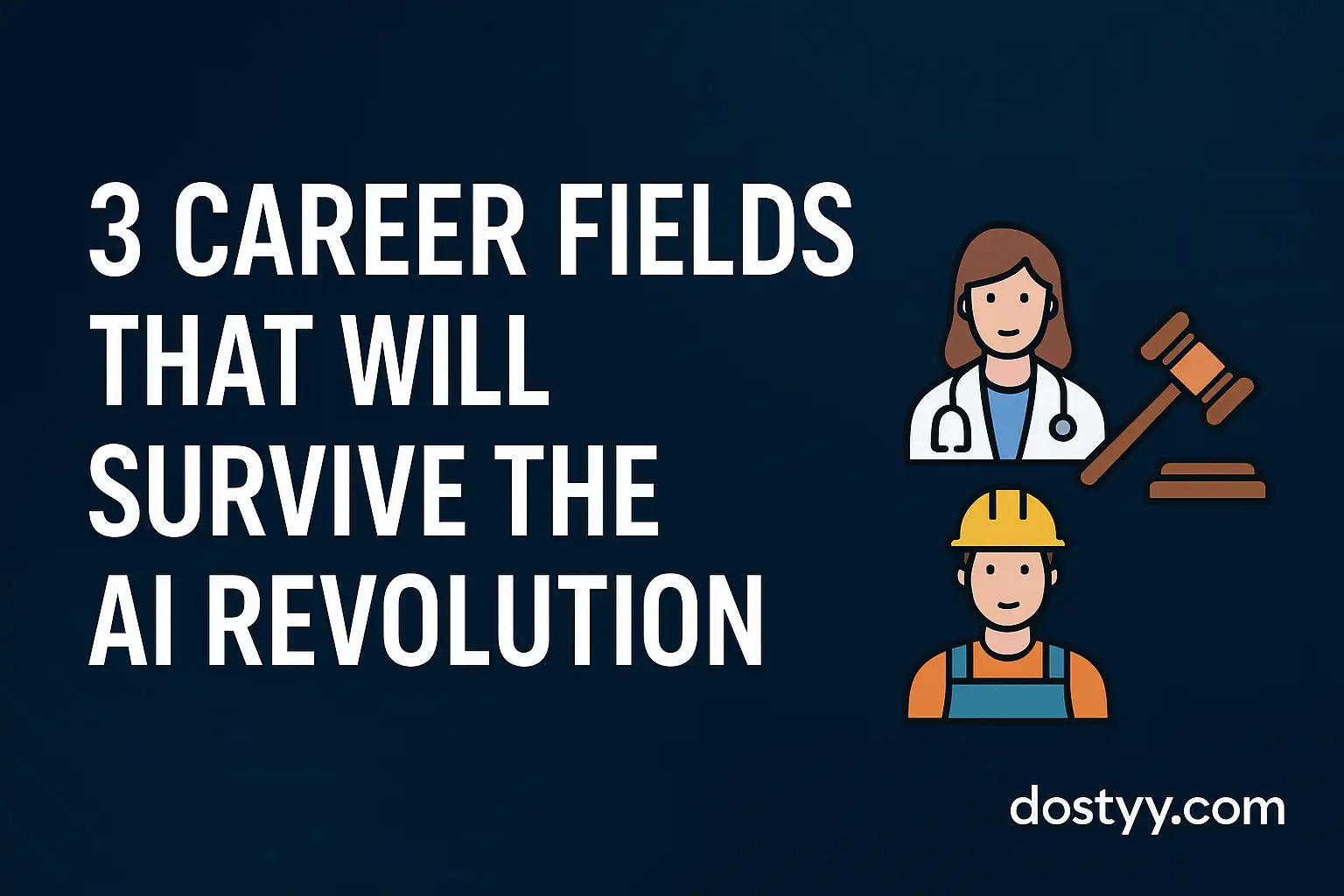
3 Career Fields That Will Survive the AI Revolution
- Jul 9, 2025
- 0
As Artificial Intelligence (AI) continues to revolutionize industries worldwide, fear of job loss is reaching record levels. In Pakistan, a country already grappling with employment issues, the emergence of AI-powered tools such as ChatGPT, Grok, and Gemini has set the debate about the future of work in earnest. Tech entrepreneur and visionary Bill Gates has entered the fray, explaining which jobs are most likely to survive in an AI-driven world.
Let's see what he has to say and learn how you can get ready for this future.
The AI Takeover: What's at Stake?
Bill Gates says we're rapidly on our way to a world where most traditional jobs will disappear or change radically because of the impact of AI. Machines are not only replacing repetitive work — they are getting faster, more intelligent, and even able to make decisions long thought to be solely the domain of humans.
So, what jobs will still matter?
1. Healthcare Professions: Where Empathy Still Counts
Despite technological advancement, the healthcare sector remains relatively AI-proof. Why? Because human interaction, compassion, and emotional intelligence are irreplaceable in caring for patients. Nurses, doctors, caregivers, and patient attendants will continue to be essential, especially in roles that require direct communication and emotional support.
Related: AI’s Impact on Jobs, Economy, and the Public – Pew Report
2. AI Development and Engineering: Constructing the Future
Although AI can perform numerous tasks automatically, it requires experts to plan, keep it in check, and oversee its systems. Engineers — software engineers, data scientists, and AI developers — will continue to be much-needed professionals. Their job of creating and improving AI technologies is irreplacable.
This is a field with bright prospects for Pakistan's tech-literate youth who are contemplating careers in web development, programming, and data science.
Discover: How AI Technologies Are Revolutionizing the Recruitment Process
3. Creative Professions: The Strength of Human Creativity
Occupations that depend on imagination, originality, and emotion — e.g., artists, writers, designers, musicians, and filmmakers — are more resistant to automation. AI can support but not substitute for the distinctive style of human creativity. Content creation, storytelling, branding, and digital media will remain to provide career opportunities with a human-centric approach.
Not Completely Safe — But More Resilient
Bill Gates points out that even these three industries are not completely safe from AI. The professions that will really endure are those rooted deep in human emotion, creative thinking, and advanced technical skill. For example, a content writer who only reworks articles will be replaced, but a writer who creates original viewpoints will remain in business.
The Road Ahead: Rethinking Skills, Education & Employment
This technology-driven revolution is an eye-opener for governments, schools, and businesses in Pakistan. Gates calls policymakers to reimagine the education system, prepare workers with skills for tomorrow, and focus on human-centered careers.
The following are some of the major things to do in preparation:
• Develop skills that machines cannot quickly replicate: communication, leadership, problem-solving.
• Investigate technical areas such as AI development and robotics.
• Welcome creativity and emotional intelligence in your professional journey.
• Upskill regularly — the world of work is changing rapidly.
Final Thoughts: The Future is Already Here
AI is not a future away — it is already redefining our world. The quicker we adapt, the sooner we can stake our claim in this new economy. For job candidates in Pakistan, the message is clear: begin preparing now.
Whether you are a student, a professional, or an employer — flexibility is your biggest asset.
0 Comments
Add your review
Explore related articles

The Punjab Enforcement and Regulatory Authority (PERA) has officially announced exciting...

dostyy
The job landscape in Punjab is transforming rapidly with the launch of the Arzi Muawin P...
dostyy

Punjab Government unveiled a new digital payment system for public transport. Chief Minister ...